
{“items”:[“603c531d76493a0017403f46″,”5f837df35e7b9f001737c174″],”styles”:{“galleryType”:”Columns”,”groupSize”:1,”showArrows”:true,”cubeImages”:true,”cubeType”:”fill”,”cubeRatio”:1.3333333333333333,”isVertical”:true,”gallerySize”:30,”collageAmount”:0,”collageDensity”:0,”groupTypes”:”1″,”oneRow”:false,”imageMargin”:32,”galleryMargin”:0,”scatter”:0,”rotatingScatter”:””,”chooseBestGroup”:true,”smartCrop”:false,”hasThumbnails”:false,”enableScroll”:true,”isGrid”:true,”isSlider”:false,”isColumns”:false,”isSlideshow”:false,”cropOnlyFill”:false,”fixedColumns”:1,”enableInfiniteScroll”:true,”isRTL”:false,”minItemSize”:50,”rotatingGroupTypes”:””,”rotatingCropRatios”:””,”columnWidths”:””,”gallerySliderImageRatio”:1.7777777777777777,”numberOfImagesPerRow”:1,”numberOfImagesPerCol”:1,”groupsPerStrip”:0,”borderRadius”:0,”boxShadow”:0,”gridStyle”:1,”mobilePanorama”:false,”placeGroupsLtr”:true,”viewMode”:”preview”,”thumbnailSpacings”:4,”galleryThumbnailsAlignment”:”bottom”,”isMasonry”:false,”isAutoSlideshow”:false,”slideshowLoop”:false,”autoSlideshowInterval”:4,”bottomInfoHeight”:0,”titlePlacement”:”SHOW_ON_THE_RIGHT”,”galleryTextAlign”:”center”,”scrollSnap”:false,”itemClick”:”nothing”,”fullscreen”:true,”videoPlay”:”hover”,”scrollAnimation”:”NO_EFFECT”,”slideAnimation”:”SCROLL”,”scrollDirection”:0,”scrollDuration”:400,”overlayAnimation”:”FADE_IN”,”arrowsPosition”:0,”arrowsSize”:23,”watermarkOpacity”:40,”watermarkSize”:40,”useWatermark”:true,”watermarkDock”:{“top”:”auto”,”left”:”auto”,”right”:0,”bottom”:0,”transform”:”translate3d(0,0,0)”},”loadMoreAmount”:”all”,”defaultShowInfoExpand”:1,”allowLinkExpand”:true,”expandInfoPosition”:0,”allowFullscreenExpand”:true,”fullscreenLoop”:false,”galleryAlignExpand”:”left”,”addToCartBorderWidth”:1,”addToCartButtonText”:””,”slideshowInfoSize”:200,”playButtonForAutoSlideShow”:false,”allowSlideshowCounter”:false,”hoveringBehaviour”:”NEVER_SHOW”,”thumbnailSize”:120,”magicLayoutSeed”:1,”imageHoverAnimation”:”NO_EFFECT”,”imagePlacementAnimation”:”NO_EFFECT”,”calculateTextBoxWidthMode”:”PERCENT”,”textBoxHeight”:0,”textBoxWidth”:200,”textBoxWidthPercent”:50,”textImageSpace”:10,”textBoxBorderRadius”:0,”textBoxBorderWidth”:0,”loadMoreButtonText”:””,”loadMoreButtonBorderWidth”:1,”loadMoreButtonBorderRadius”:0,”imageInfoType”:”ATTACHED_BACKGROUND”,”itemBorderWidth”:1,”itemBorderRadius”:0,”itemEnableShadow”:false,”itemShadowBlur”:20,”itemShadowDirection”:135,”itemShadowSize”:10,”imageLoadingMode”:”BLUR”,”expandAnimation”:”NO_EFFECT”,”imageQuality”:90,”usmToggle”:false,”usm_a”:0,”usm_r”:0,”usm_t”:0,”videoSound”:false,”videoSpeed”:”1″,”videoLoop”:true,”jsonStyleParams”:””,”gallerySizeType”:”px”,”gallerySizePx”:940,”allowTitle”:true,”allowContextMenu”:true,”textsHorizontalPadding”:-30,”itemBorderColor”:{“value”:”rgba(242, 242, 242, 0.75)”},”showVideoPlayButton”:true,”galleryLayout”:2,”targetItemSize”:940,”selectedLayout”:”2|bottom|1|fill|true|0|true”,”layoutsVersion”:2,”selectedLayoutV2″:2,”isSlideshowFont”:false,”externalInfoHeight”:0,”externalInfoWidth”:0.5},”container”:{“width”:940,”galleryWidth”:972,”galleryHeight”:0,”scrollBase”:0,”height”:null}}

When it comes to adventure paddling the gear requirements are markedly different from the average outing on the water. For me, the word adventure is synonymous with gear and over the years I’ve come to appreciate having the right items to suit the task. The right gear should accentuate your outdoor experience. It should help you go further and have a more complete adventure. And when the task at hand is paddling down a rocky river or exploring a rugged section of coastline, no single water shoe I’ve tried is more suited to conquer as wide a range of terrain than the Merrell All Out Blaze Aero Sport.
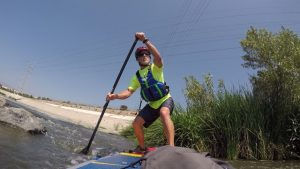
Riding bumps down the Los Angeles River on a Hala Radito.
As the name suggests, the All Out Blaze Aero Sport is built on Merrell’s highly versatile All Out Blaze platform. Unlike the other models in the range, the Aero Sport package is a full coverage shoe weighing in at a mere 1 lb 6 oz. For those of you at home, that is ultra-light for a full coverage adventure water shoe. Merrell achieved this by creating an all mesh upper which has the effect of instantaneously shedding water. The shoes have a bellows tongue to help keep out debris and a grippy Vibram outsole with 5mm lugs. You can easily go anywhere with these on your feet. Perfect for adventure paddling and whitewater trips.
I’ve worn my pair on an exploration of the Palos Verdes Peninsula and can’t imagine doing the trip without them. The All Out Blaze Aero Sport have a secure glove-like fit that doesn’t slip around when wet. Wear them just as you would a pair of sandals, e.g. no socks, and paddle along rugged terrain without worrying about cutting your feet or jamming your toes. I also used them on multiple paddling trips down the Los Angeles River with equal success. Footwear is essential when paddling on a river due to increased likelihood of coming in contact with rocks and other obstacles. The lightweight of the All Out Blaze Aero Sport water shoe does not inhibit your movement on a SUP and worked well in conjunction with the deck pad on my Hala Radito.
Great shoes for an aquatic environment – they’ll go anywhere!

Exploring the Palos Verdes coastline on a Hala Playa.
Paddling is fun. Paddling to honor a friend is meaningful. Showing up at 3:00 am on a cold January morning makes for a memorable beginning to an epic morning on the water. I drove down to Baby Beach in Dana Point Harbor from Los Angeles late Sunday evening and camped out in the back of my Jeep so I would be “on location” for the early morning launch of the second annual Paddle 4 Ray. I had paddled at a handful of events with Ray Nosse and we always made a point to connect wherever we were from the Adler Paddler in Long Beach to Race the Lake of the Sky in Lake Tahoe. I missed the inaugural Paddle 4 Ray organized by Performance Paddling and was crossing the Catalina Channel in an OC-6 on the day of his celebration of life last September. I therefore wanted to do everything I could to make it down for the paddle this year.
I had been suffering from a cold all last week, I still have a lingering, phlegm laced cough that just won’t go away, and despite having spent considerably more time paddling an OC-1 than a SUP over the course of the past few months, I didn’t hesitate at the thought of joining the Performance Paddling crew for a 32 mile paddle (16 laps around Dana Point Harbor) to remember our friend.

Ray Nosse commemorative stone – Paddle 4 Ray.
Twelve paddlers, plus Mama C. – a Baby Beach icon, arrived for the 3:00 am start and after a few obligatory pre-event photos we were led out into the dark water by Performance Paddling founder Anthony Vela. Vela has spent so much time paddling in Dana Point Harbor he can probably navigate the area with his eyes closed and he proved to be the perfect host/lap counter for the event which quickly took on the air of an expedition. In a move to keep the circular course interesting, we alternated between a clockwise and counterclockwise course each lap. We moved along at an approximately 4.5 mph pace, at times forming draft trains and at other times moving en masse across the water.
The wind gradually picked up creating an up wind and downwind leg of equal length as our procession continued its transit through the harbor. Somewhere between the 20-24 mile a bit of soreness began to creep into my shoulders as I occasionally adjusted my hand position on my paddle to relieve the pressure on my lower back – the latter a tip passed on from Vela which originated with Danny Ching, a guy who is no stranger to grinding, long distance paddles.
I’m not sure if everyone from the original 12 stayed until the end – each lap became a bit of a blur, but numerous additional paddlers popped in and out throughout our memorial paddle. We briefly paused for roughly two minutes after each lap to share nutrition, hydration, hugs and high fives. Jenny Kingsley brought a batch of homemade golf ball shaped nutrition snacks, aka Power Balls – they were incredibly good and I’m confident they taste equally amazing when you’re not worn out from paddling.
New paddlers were ceremoniously welcomed upon arrival and departed friends sent off with equal veneration. It didn’t matter if you paddled two miles or 32, what mattered is that you were there.
You are missed by many Ray Nosse, but your memory lives on.
#performancepaddling #SUPEvent #Paddle4Ray #DanaPoint #DanaPointHarbor
Here’s the dilemma: You’re looking for your first paddleboard and you are suddenly bombarded by boards. All-around boards. Wave runners! Tourers! Downwind boards! Which one do you pick? Most people will purchase an all-arounder, which are the bread-and-butter rides of the stand up paddling world. It seems like a safe decision, right? Buy something that is designed for all sorts of conditions. On the whole, it is a good choice, but to understand why, let’s get into what makes an all-around board.
If you think all-around look like big surfboards, that’s because, well, they sort-of are. They have the same flat bottom which is called a planing hull. This is so when the board is on the wave, it’s designed to plane over the surface of the water. This allows surfers to complete fancy turns and tricks surfer. Because of this, all-rounders make fair surf SUPs. As a matter of fact, in small waves they are excellent surf SUPs. The reason is that their large size and volume allows the paddler to catch a small wave easily.
Pros and Cons of All-Around Boards
The problem is when you want to do more than just ride a wave straight in. You can do a simple turns pretty easily, but not much else. An all-around is just too big for tricks. They’re designed that way — the extra volume makes the board float better, which makes it appropriate for beginners. The thing is, when the waves get bigger, these huge rides become difficult to control. Size and volume matters here. When waves get above waist high, then the smaller rides rule. That’s why when you see experienced surfers on big waves, they’re riding tiny potato-chip style boards.

The rounded tail allows the surf SUP to turn easier. The square tail of the all-around is little faster.
Another issue with an all-around board is that they tend to have very little rocker. Rocker is the curve of the board from nose to tail, so a board without much rocker — like an all-around — will be pretty straight. When you’re paddling on flatwater this is a good thing because it makes the board go faster. Unfortunately it’s a problem on the waves. Surf SUPs need a fair amount of rocker because it keeps the nose of the board from “pearling” or digging into the water as the board goes down a wave face. You can easily tell the difference between a surf and all-around SUP by looking at the nose. A surf SUP will have an upturned nose, and an all-around board’s nose will be much straighter and thicker. No matter what the nose shape, however, for learning on the small stuff, there’s probably nothing better than an all-around.
Flatwater paddling is where you usually see all-around boards, and this means another set of compromises. For the beginner paddler, a large, stable all-around can be pretty nice. They’re wide, which means they’re easy to learn on. If you get one with tie-downs (highly recommended!) you can carry water, cameras, bags and other gear with you. They are easy to paddle and handle. What could be the problem?
The compromise of an all-around board is speed and dealing with choppy conditions. It gets back to that plaining hull design. It lets you surf but it tends to be fairly slow on flatwater. Consider it this way: a planing hull is designed to go over the water, which is perfect for the waves. Unfortunately, on flat water the fastest way to travel is through the water. That’s why you see kayak-style noses on touring and racing boards. These sharp noses also cut through chop. Unfortunately, the round, flat nose of an all around will usually slam into chop, making a rough a ride, especially when going upwind.
To be clear, the same shape that allows this board to surf makes it slower during general paddling. This means that all-arounds aren’t great choices for distance paddling. Nor are they good race boards unless you compete in the surfboard category, which, yes, exists. That doesn’t mean that these boards aren’t capable; it just means that your pace will be a little more leisurely. A board with tie-downs in the front will also make it easier to carry gear just in case you do that longer paddle.
All the compromises aside, if you plan on dipping your foot into standup paddling and going everywhere, this jack-of-all-trades is an excellent choice. No question, they’re easy to paddle. They also tend to be less expensive than more specialized boards. Many can be purchased at half the price of a specialized board, and even less used. If you graduate to something more specialized, there are still great reasons to keep it around. They are excellent for teaching beginners. It makes a great “vacation board” — when you can only bring one board with you and you need a ride that will do everything. You’ll also always have an extra ride for that special someone, which is always nice.
 Photo: Ismail Niyax at Unsplash
The Division of Boating and Waterways (DBW) announced plans for this year’s control efforts for aquatic invasive plants in the Sacramento-San Joaquin Delta and its southern tributaries. Consistent with COVID-19 safety protocols, DBW personnel started herbicide treatments today to help control several invasive plants found in the Delta.
Treatment start dates and treatment sites may change depending on weather conditions, plant growth and movement, waterway traffic, location of sensitive species, presence of sensitive crops in adjacent lands, and other conditions.
“Invasive plants displace native plants in the Delta, create hazards for boaters and obstruct water ways and irrigation systems. DBW is putting technology and resources to work to limit these impacts,” said DBW’s Acting Deputy Director Ramona Fernandez. “We work collaboratively and in cooperation with the public and our local, state and federal partners who help us manage this challenge.”
The invasive plants include water hyacinth, South American spongeplant, Uruguay water primrose, Alligator weed, Brazilian waterweed, curlyleaf pondweed, Eurasian watermilfoil, hornwort (aka coontail), and fanwort.
Aquatic invasive plants have no known natural controls. Continued warm temperatures help the plants grow at high rates. Plants are also known to form dense mats of vegetation creating safety hazards for boaters, obstructing navigation channels, marinas and irrigation systems. Due to their ability to rapidly spread to new areas, it is likely that the plants will never be eradicated from Delta waters. Therefore, DBW’s program works to control rather than eradicate the plants. The division works with local, state, and federal entities to better understand the plants and implement new integrated control strategies to increase efficacy. Public engagement is also key in DBW’s efforts.
All herbicides used in the program are registered for aquatic use with the U.S. Environmental Protection Agency and the California Department of Pesticide Regulation.
Treated areas will be monitored to ensure herbicide levels do not exceed allowable limits and follow EPA-registered label guidelines. The public may view the public notices, treatment area maps and sign up to receive weekly updates on this year’s treatment season and public opportunities on DBW’s website.
Below is a list of proposed control actions for the 2021 treatment season.
Floating Aquatic Vegetation Control Program
Water hyacinth, South American spongeplant, Uruguay water primrose and alligator weed.
Herbicide Control
-
Treatment Period
-
Select Area 1 Sites and Areas 2-4: March 19, 2021 – Nov. 30, 2021
-
Note all Area 1 Sites: north of Hwy 12, Glyphosate and Imazamox are only being used.
-
Type of Herbicides: In areas 2-4 Glyphosate, 2,4-D, Diquat, Imazamox or Penoxsulam.
-
Potential Treatment Areas: Initially in and/or around, but not limited to the following areas: San Joaquin River, Old River, Middle River, Fourteen Mile Slough, and Piper Slough.
Mechanical Harvesting (If necessary)
-
Harvesting Dates: March 2021 – April 2021 and July 2021 – Dec. 2021
-
Mechanical Harvesting Sites: Select areas of the Delta with high infestations or coverage of water hyacinth. See map for potential mechanical harvesting control areas.
Submersed Aquatic Vegetation Control Program
Brazilian Waterweed, curlyleaf pondweed, Eurasian watermilfoil, coontail/hornwort and fanwort.
Herbicide Control
-
Treatment Period: Starting March 19, 2021 through Nov. 30, 2021, treatment period based upon DBW field survey data, water temperatures and fish surveys.
-
Type of Herbicide: Fluridone or Diquat.
-
Potential Treatment Areas: In and/or around the following areas (individual areas will be noticed prior to treatment application):
-
Anchorages, boat ramps and marinas: B & W Resort, Delta Marina Rio Vista, Hidden Harbor Resort, Korth’s Pirates Lair, New Hope Landing/Wimpy’s Marina, Owl Harbor, Oxbow Marina, Rivers End, Spindrift Marina, St. Francis Yacht Club, Tiki Lagoon, Turner Cut Resort, Vieira’s Resort, Village West Marina, and Willow Berm.
-
Near Old River: Cruiser Haven, Delta Coves, Diablo Ski Club, Discovery Bay, Hammer Island, Piper Slough, Quin’s Island, Sandmound Slough, Taylor Slough, Italian Slough, and Kings Island.
-
Sacramento Area: French Island, Long Island Slough, Prospect Island, Snug Harbor, The Meadows, and Washington Lake.
-
Stockton Area: Atherton Cove, Calaveras River, Fourteenmile Slough, Mosher Slough, and Windmill Cove.
-
Antioch Area: Winter Island and Emerson Slough
Mechanical Harvesting
This type of control method is not used for submersed aquatic vegetation. These plants spread by fragmentation. Cutting the plants back exacerbates the problem, as shreds of the plants float away and re-propagate.
DBW works with local, state and federal entities to better understand the plants and implement new integrated control strategies to increase efficacy.
Last year, DBW treated 1,869 acres of floating aquatic vegetation and 2,056 acres of submersed aquatic vegetation. No mechanical harvesting was conducted. A combination of herbicide, biological and mechanical control methods were used to help control invasive plants at high priority sites in the Delta.
During the COVID-19 pandemic, DBW has provided training to staff to help reduce the risk of exposure to the virus while conducting treatments. As the state continues to issue guidance on preparing and protecting all Californians from the pandemic, the California Department of Parks and Recreation is monitoring the situation closely and is following guidance provided by the Governor’s Office and the California Department of Public Health, the Centers for Disease Control and Prevention, the Governor’s Office of Emergency Services, and local public health departments.
Funding for DBW’s AIPCP comes from the Harbors and Watercraft Revolving Fund, which receives revenues from boaters’ registration fees and gasoline taxes.
In 1982, California state legislation designated DBW as the lead state agency to cooperate with other state, local and federal agencies in controlling water hyacinth in the Delta, its tributaries, and the Suisun Marsh. The Egeria Densa Control Program was authorized by law in 1997 and treatment began in 2001. In 2012, spongeplant was authorized for control upon completion of the biological assessment. In 2013, DBW was able to expand its jurisdiction to include other AIPs, and since then other plants such as Uruguay water primrose, Eurasian watermilfoil, Carolina fanwort, coontail/hornwort, and Alligator weed have been added to the AIPCP program.
To report sightings, subscribe for program updates or for more information regarding the control program, connect with DBW online at dbw.parks.ca.gov/AIS, via email at [email protected] or by phone (888) 326-2822.
Beach Eats TO GO resumes this Thursday, May 28th at its new location in Lot 11 (14101 Panay Way, Marina del Rey) from 5 p.m. to 9 p.m. Now through September 24th, some of Los Angeles’ most popular food trucks will be featured to bring you delectable food options. Beach Eats TO GO is a grab and go, ONLINE ORDERING ONLY event. No cash or credit card transactions will be accepted on-site.
Visit bestfoodtrucks.com/beacheatstogo to place your order, select your pick-up time, and check out the food truck lineup in the coming weeks You can even place your online order up to 48 hours before each Beach Eats TO GO and select a pick-up time on Thursday that works for you.
This week’s food truck lineup includes:
-
Habibi Shack (Mediterranean)
-
Roll’n Lobster (Seafood)
-
Maravilla Latin Cuisine (Mexican)
Unlike the traditional Beach Eats weekly food truck event, Los Angeles County Department of Beaches and Harbors has modified it to comply with COVID-19 precautions and L.A. County Department of Public Health directives. A face covering and a 6-foot physical distance from other patrons is required. Please note that picnicking in the parking lot or on Mother’s Beach is prohibited and adjacent picnic tables are closed to the public until further notice. Please enjoy your order in the comfort of your own home.
Parking is available in Lot #11 at a rate of $0.25 for each 10 minutes. There is a $2 minimum for credit card payments.
For the weekly schedule of trucks, visit bestfoodtrucks.com/beacheatstogo.
Beach Eats TO GO resumes this Thursday, May 28th at its new location in Lot 11 (14101 Panay Way, Marina del Rey) from 5 p.m. to 9 p.m. Now through September 24th, some of Los Angeles’ most popular food trucks will be featured to bring you delectable food options. Beach Eats TO GO is a grab and go, ONLINE ORDERING ONLY event. No cash or credit card transactions will be accepted on-site.
Visit bestfoodtrucks.com/beacheatstogo to place your order, select your pick-up time, and check out the food truck lineup in the coming weeks You can even place your online order up to 48 hours before each Beach Eats TO GO and select a pick-up time on Thursday that works for you.
This week’s food truck lineup includes:
-
Habibi Shack (Mediterranean)
-
Roll’n Lobster (Seafood)
-
Maravilla Latin Cuisine (Mexican)
Unlike the traditional Beach Eats weekly food truck event, Los Angeles County Department of Beaches and Harbors has modified it to comply with COVID-19 precautions and L.A. County Department of Public Health directives. A face covering and a 6-foot physical distance from other patrons is required. Please note that picnicking in the parking lot or on Mother’s Beach is prohibited and adjacent picnic tables are closed to the public until further notice. Please enjoy your order in the comfort of your own home.
Parking is available in Lot #11 at a rate of $0.25 for each 10 minutes. There is a $2 minimum for credit card payments.
For the weekly schedule of trucks, visit bestfoodtrucks.com/beacheatstogo.
A version of this article in Japanese is available at the conclusion of the original text. The Japanese version is made possible through a partnership between SUP Examiner & Everything SUP Japan.
Easy tips to get the most from your SUP paddle
As is the case with SUPs, paddles should be cared for in order to ensure you get the most out of your investment. A good quality carbon fiber SUP paddle can easily last you a lifetime if it is properly looked after. For new paddlers or for individuals who may have specific equipment requirements such as a whitewater paddler, paddles with a fiberglass blade are a great option due to their ability to withstand rock strikes and hold up against any unintentional wear and tear that may occur.
Keep it in a paddle bag
Unless you are someone who is fortunate enough to be able to walk directly from your home to the water, it is a good idea to protect your SUP paddle with a paddle bag. The blade is the most vulnerable part of any paddle and if a full paddle bag is not for you, you can protect the blade by fitting your paddle with a blade cover. Think of a blade cover as a sock with a zipper that fits over the paddle blade.
Transport with care
Be mindful of where you place your SUP paddle, even if it is in a paddle bag. When transporting your paddle in a vehicle, make sure your paddle does not have anything heavy lying on top of it which could place a strain on its structural integrity. Similarly, never wedge your paddle into a sharp angle. Last, but not least, take care to check to be sure your paddle does not get crushed in a door jam.
Keep it clean
You probably would not pick up a dirty fork and begin to eat. Paddling is no different. Rinse and clean your paddle after each use – especially if you are paddling in salt water. If you have an adjustable paddle with moving parts, go ahead and disassemble your paddle and rinse each section.
Inspect before and after use
Before you head out on the water you should always inspect your equipment. Examine your paddle’s blade and shaft and look for any nicks or dings which may require a repair. Many blade dings, even large ones, can be sanded back into shape with wet sandpaper. If there is a crack anywhere on your paddle you should have it repaired either by the shop where you made the purchase or return it to the manufacturer if it is still covered by a warranty.
Last out and first in
My paddle is typically one of the final items I take out of my car and the first thing I put away. I adopted this habit to minimize the chances my paddle would ever be knocked over, stepped on or run over by a vehicle in the parking lot. I recommend never laying your paddle on the ground or up against a vehicle in a parking lot. In the rare times I do lean my paddle against my vehicle, I like to place it in the nook between one of the side mirrors and the vehicle so it doesn’t accidentally fall over and get stepped on.
The Japanese version is made possible through a partnership between SUP Examiner & Everything SUP Japan.
Easy Tips to Get the Most From Your SUP Paddle
パドルを最大限活用するコツ
SUPの場合、パドルにせっかく投資されたのですから、それに見合うお手入れをどうぞお忘れなく。品質の高いカーボンファイバーSUPパドルは、きちんとケアされていれば一生使えます。初心者やホワイトウォーターパドラーのような特別なギアを必要とするパドラーには、ファイバーガラスブレードのパドルが最適です。このタイプのパドルは岩と接触したような場合でも損傷しにくく、また使用に伴う自然劣化にも強い性質を持っています。
Keep it in a Paddle Bag
パドルはパドルバッグに
水辺から家まで徒歩ですぐ行けるラッキーな人以外、SUPパドルはパドルバッグに入れて移動されることをお勧めします。どんなパドルでもブレードが最も重要なパーツですので、もしパドルごと入れられるフルバッグがお好きでない場合は、ブレードカバーでブレードを守りましょう。ブレードカバーはブレードを守ってくれるチャックの付いた靴下みたいなものです。
Transport With Care
移動の際は気を付けて
SUPパドルをパドルバッグの中に入れている場合でも、パドルの位置を意識しておいてください。車でパドルを運ぶ際は、構造にダメージをきたす可能性のある重い物が上に積まれていないか確認してください。またパドルに上から必要以上の圧力をかけないようにしてください。最後に、パドルをドアに挟まないようにご注意ください。
Keep it Clean
いつも清潔に
おそらく皆さんは食事の際、汚れたお箸を使おうとは思わないでしょう。パドリングも同じです。使用後はきちんと水ですすいで汚れを落としてください。塩水でパドルされる場合は特にお手入れをお忘れなく。調節パーツがついているアジャスタブルパドルは、分解してすべてのパーツを洗い流してください。
Inspect Before and After Use
使用前後にチェック
パドルを始める前に必ずギアの確認をお勧めします。パドルブレード、シャフトをよく見て、修理が必要なところがないかチェックしてください。多くの場合、ブレードにはよく大小のへこみが見つかりますが、ウェットサンドペーパーを使って修理することが可能です。もしヒビを発見した場合は、購入されたショップで修理してもらうか、保証期間内であればメーカーに修理を依頼してください。
Last Out and First In
最後に出して最初に入れる
いつも私はパドルを車から最後に出して、最初にしまいます。理由はパドルが倒れたり、踏んでしまったり、駐車場で車にひかれたりするリスクを最小限にする為です。地面に寝かせたり、駐車場で車に立てかけたりする事は決してお勧めしません。私もまれにパドルを車に立てかける事がありますが、その際倒れたり、踏んだりしないように、サイドミラーと車の間にある隙間にパドルを置きます。
この記事はSUP ExaminerとEverything SUP Japanが共同でお送りしてます。
マット・チェバトリス
SUP Examinerの創設者
元国家安全保障の専門家の一方、冒険家としての人生を謳歌している。これまで外交政策の分野で様々な資料を発表。また、スポーツの楽しさを共有するための場としてSUP Examiner™を設立。現在、妻のカレン、タキシードキャットのマクシミリアンと共にロサンゼルス在住。
#MaintenanceTips #SUPPaddle #howto #PaddleCare #JapaneseVersion
 Photo by Maya Tani on Unsplash
Registration opened on February 14, 2021 for the 22nd Yukon River Quest (YRQ), which will be held June 23 to June 26, 2021. The event was cancelled in 2020 but will go forward this summer under COVID-19 health and travel mandates. As such, race registration will initially be limited to Yukon and Canadian teams only. Yukon teams currently on hold from the cancelled 2020 event will be registered first.
All international teams that were previously registered from 2020 will be withdrawn but will have the option of getting on a wait list for entry if travel restrictions are lifted before the race. They will not lose their spots in the queue.
The 715-kilometer (444-mile) marathon paddling race is run on the Yukon River from Whitehorse to Dawson City in Canada’s Yukon Territory during the last week of June. The race passes through the traditional lands of five Yukon First Nations and honours the cultures of those who have lived off the river and nurtured it for centuries.
The “Race to the Midnight Sun” for many years was the world’s longest annual paddling race and remains unique because teams race round-the-clock on a wilderness river and under a sky that never gets dark.
The allure of the Yukon River has made the YRQ a huge success. In the two years preceding the COVID pandemic, more than 100 teams registered, prompting race officials to adjust the team registration limit to 125 teams. During the last race in 2019, a record 117 teams were at the start line, and 86 of them finished.
The 2021 race may be limited in numbers due to health mandates, and several COVID-prevention procedures are in the process of being adopted in order to have a safe event on the river and in our communities.
For example, Canadian teams outside of the Yukon and any support crew members in their bubble currently would have to quarantine in the territory for 14 days prior to the event. It is hoped some restrictions will be modified as we move into summer, but the health of our territory’s residents, along with our volunteers and paddlers, is top priority.
Despite anticipated restrictions, the race will go on. Peter Coates, president of the Yukon River Marathon Paddlers Association (YRMPA), explained the board’s reasoning for moving forward with a race in 2021:
“The race will happen, come hell or high water, preferably high water. People need something to look forward to, and even if it is just a local race it keeps the name alive,” Coates said.
Online entry forms are available starting at 14:00 (2 PM) Mountain Standard Time on February 14 via a link under the Register tab on the race website https://www.yukonriverquest.com. Entry fees for the full YRQ are: $650 per solo team (C1, K1, SUP); $950 per tandem team (C2, K2); and $1550 for a C4 team, $2150 for a 6-person voyageur canoe (VC) team, and $2750 for an 8-person VC. Payment is required at time of registration to secure a spot.
While the overall limit of 125 teams likely will be reduced, there also is a voyageur canoe limit of 15 teams, and a solo team limit of 50 teams. Solo paddlers who have not completed a YRQ must provide a satisfactory paddling resume prior to registration to demonstrate that they have sufficient marathon racing or wilderness paddling experience. Paddling resumes should be e-mailed to the race office at [email protected]. See Register page for more details.
New this year for teams that want to get a feel for the race but not commit to the full YRQ experience is the Half Quest, which will end in Carmacks. A separate set of rules including entry fees is now posted on the website. It is hope that a lot of local Yukon teams will take advantage of this opportunity to race on the river. Regardless of which race you choose, you need to be prepared.
“Prospective paddlers thinking about entering need to be aware that this is a race that is tough mentally and physically,” Coates said. “Be prepared to be cold and sore, mentally and physically exhausted, out in the middle of nowhere. A very beautiful but unforgiving nowhere. Do not enter on a whim, but only if you are up to the challenge.”
All paddlers should become familiar with details in the 2021 YRQ COVID Rules, which are posted in English on the website, along with several preparation tips. Each team is required to have a SPOT, IN REACH, or similar tracking device mounted on top of their vessel and activated for tracking before the team is officially allowed to race. This requirement allows teams to be able to be tracked during the race from links on the Yukon River Quest website. Following the actual race live online has been hugely popular with spectators all over the world. During recent races, the reach exceeded more than 30,000 via the event’s Facebook and Instagram pages. Total possible prize money for the full YRQ remains at $42,830, based on 100 teams registered by June 1.
The purse is adjusted upward or downward by a percentage point based on the final number of teams registered above or below 100. The top three male, female and mixed teams per class receive prize money as long as they beat another team in its class and finish within 25% of the top team in the class. Bonus prize money also will be given in several areas to: the top 10 teams overall; any team that breaks a record in its class; the top All-Indigenous team; the top Yukon male, female and mixed teams; the top senior team (age 55 and over), and the top young adult team (age 19-24). Several special awards are also donated by Yukon sponsors. A complete prize breakdown can be found in the race rules on the website.
There will be no prize money for the Half Quest in this experimental year. However, many do the race for the personal satisfaction of staking their claim to a coveted YRQ Finisher Pin (there also will be Half Quest pins). Paddlers who have finished multiple YRQs also now covet entrance into the “Great River Club” which was
unveiled for the 20th anniversary. Racers who have logged 5,000 and 10,000 kilometers are members of that club and receive special pins. For more information visit the Great River Club page https://www.yukonriverquest.com/great-river-club/ ”
The full race is all about endurance. Aside from two mandatory layovers at Coal Mine Campground in Carmacks and Minto Resorts (new this year), teams paddle non stop to reach Dawson City. Teams in the full YRQ will have the option of choosing their rest times at the two layover locations, as long as they add up to 10 hours.
The YRQ course record still belongs to Canadian voyageur Team Kisseynew’s winning time of 39 hours, 32 minutes, 43 seconds in 2008. The 2019 overall winning time was 44:59:10 by the C2 team #wepaddletogether (Mike Vincent and Ivan English) of Saskatchewan, Canada.
The race’s continued success depends on hundreds of dedicated volunteers, who are greatly appreciated by our racers and have a good time helping out during the last week of June. Various volunteer opportunities are listed under the Volunteer page on the website, where you can see the various jobs and shifts and sign up online.
Watch for a schedule and more news about YRQ events as we move into spring. YRMPA also welcomes new members.
The Yukon River Quest is the premier paddling event in Canada’s North and is widely recognized throughout the paddling and adventure racing world. It has been featured in numerous publications, online, and in shows on NBC-TV, the BBC, and the CBC. The YRQ was named one of the ten toughest races in the world by renowned adventure racer and “Boundless” TV star Simon Donato. The race typically draws an international field, which we hope will be back in 2022. In 2019, 13 countries were represented.
The race was beautifully featured a decade ago in the National Film Board of Canada’s critically acclaimed “River of Life” about Paddlers Abreast, a voyageur team of Yukon breast cancer survivors that races every year. In 2021, they will be celebrating their 20th anniversary. Many other worthy causes have been represented as well.
Major logo-level sponsors are: Yukon 1000 Race Timing Software, Gold Trail Jewellers, Paddel Jumper, CKRW-The RUSH, Air North, Kanoe People, Whitehorse Star, PR Services-yukoninfo.com, Pepsi–Aquafina, City of Whitehorse, Up North Adventures, Superior Roofing YT, Total North Communications, Yukon Civil Air Search & Rescue (CASARA), Yukon Wide Adventures, The Coal Mine Campground, Minto Resorts, Fireweed Helicopters, North 60 Petro, and Make IT Solutions.
Many small businesses also have supported the race by sponsoring paddler bibs – see details on the website or contact the race office at 867-333-5628. For more information, view the pre-registration instructions, rules, and numerous paddler preparation links at www.yukonriverquest.com and watch for updates on Facebook.
Photo: Ismail Niyax at Unsplash
The Division of Boating and Waterways (DBW) announced plans for this year’s control efforts for aquatic invasive plants in the Sacramento-San Joaquin Delta and its southern tributaries. Consistent with COVID-19 safety protocols, DBW personnel started herbicide treatments today to help control several invasive plants found in the Delta.
Treatment start dates and treatment sites may change depending on weather conditions, plant growth and movement, waterway traffic, location of sensitive species, presence of sensitive crops in adjacent lands, and other conditions.
“Invasive plants displace native plants in the Delta, create hazards for boaters and obstruct water ways and irrigation systems. DBW is putting technology and resources to work to limit these impacts,” said DBW’s Acting Deputy Director Ramona Fernandez. “We work collaboratively and in cooperation with the public and our local, state and federal partners who help us manage this challenge.”
The invasive plants include water hyacinth, South American spongeplant, Uruguay water primrose, Alligator weed, Brazilian waterweed, curlyleaf pondweed, Eurasian watermilfoil, hornwort (aka coontail), and fanwort.
Aquatic invasive plants have no known natural controls. Continued warm temperatures help the plants grow at high rates. Plants are also known to form dense mats of vegetation creating safety hazards for boaters, obstructing navigation channels, marinas and irrigation systems. Due to their ability to rapidly spread to new areas, it is likely that the plants will never be eradicated from Delta waters. Therefore, DBW’s program works to control rather than eradicate the plants. The division works with local, state, and federal entities to better understand the plants and implement new integrated control strategies to increase efficacy. Public engagement is also key in DBW’s efforts.
All herbicides used in the program are registered for aquatic use with the U.S. Environmental Protection Agency and the California Department of Pesticide Regulation.
Treated areas will be monitored to ensure herbicide levels do not exceed allowable limits and follow EPA-registered label guidelines. The public may view the public notices, treatment area maps and sign up to receive weekly updates on this year’s treatment season and public opportunities on DBW’s website.
Below is a list of proposed control actions for the 2021 treatment season.
Floating Aquatic Vegetation Control Program
Water hyacinth, South American spongeplant, Uruguay water primrose and alligator weed.
Herbicide Control
-
Treatment Period
-
Select Area 1 Sites and Areas 2-4: March 19, 2021 – Nov. 30, 2021
-
Note all Area 1 Sites: north of Hwy 12, Glyphosate and Imazamox are only being used.
-
Type of Herbicides: In areas 2-4 Glyphosate, 2,4-D, Diquat, Imazamox or Penoxsulam.
-
Potential Treatment Areas: Initially in and/or around, but not limited to the following areas: San Joaquin River, Old River, Middle River, Fourteen Mile Slough, and Piper Slough.
Mechanical Harvesting (If necessary)
-
Harvesting Dates: March 2021 – April 2021 and July 2021 – Dec. 2021
-
Mechanical Harvesting Sites: Select areas of the Delta with high infestations or coverage of water hyacinth. See map for potential mechanical harvesting control areas.
Submersed Aquatic Vegetation Control Program
Brazilian Waterweed, curlyleaf pondweed, Eurasian watermilfoil, coontail/hornwort and fanwort.
Herbicide Control
-
Treatment Period: Starting March 19, 2021 through Nov. 30, 2021, treatment period based upon DBW field survey data, water temperatures and fish surveys.
-
Type of Herbicide: Fluridone or Diquat.
-
Potential Treatment Areas: In and/or around the following areas (individual areas will be noticed prior to treatment application):
-
Anchorages, boat ramps and marinas: B & W Resort, Delta Marina Rio Vista, Hidden Harbor Resort, Korth’s Pirates Lair, New Hope Landing/Wimpy’s Marina, Owl Harbor, Oxbow Marina, Rivers End, Spindrift Marina, St. Francis Yacht Club, Tiki Lagoon, Turner Cut Resort, Vieira’s Resort, Village West Marina, and Willow Berm.
-
Near Old River: Cruiser Haven, Delta Coves, Diablo Ski Club, Discovery Bay, Hammer Island, Piper Slough, Quin’s Island, Sandmound Slough, Taylor Slough, Italian Slough, and Kings Island.
-
Sacramento Area: French Island, Long Island Slough, Prospect Island, Snug Harbor, The Meadows, and Washington Lake.
-
Stockton Area: Atherton Cove, Calaveras River, Fourteenmile Slough, Mosher Slough, and Windmill Cove.
-
Antioch Area: Winter Island and Emerson Slough
Mechanical Harvesting
This type of control method is not used for submersed aquatic vegetation. These plants spread by fragmentation. Cutting the plants back exacerbates the problem, as shreds of the plants float away and re-propagate.
DBW works with local, state and federal entities to better understand the plants and implement new integrated control strategies to increase efficacy.
Last year, DBW treated 1,869 acres of floating aquatic vegetation and 2,056 acres of submersed aquatic vegetation. No mechanical harvesting was conducted. A combination of herbicide, biological and mechanical control methods were used to help control invasive plants at high priority sites in the Delta.
During the COVID-19 pandemic, DBW has provided training to staff to help reduce the risk of exposure to the virus while conducting treatments. As the state continues to issue guidance on preparing and protecting all Californians from the pandemic, the California Department of Parks and Recreation is monitoring the situation closely and is following guidance provided by the Governor’s Office and the California Department of Public Health, the Centers for Disease Control and Prevention, the Governor’s Office of Emergency Services, and local public health departments.
Funding for DBW’s AIPCP comes from the Harbors and Watercraft Revolving Fund, which receives revenues from boaters’ registration fees and gasoline taxes.
In 1982, California state legislation designated DBW as the lead state agency to cooperate with other state, local and federal agencies in controlling water hyacinth in the Delta, its tributaries, and the Suisun Marsh. The Egeria Densa Control Program was authorized by law in 1997 and treatment began in 2001. In 2012, spongeplant was authorized for control upon completion of the biological assessment. In 2013, DBW was able to expand its jurisdiction to include other AIPs, and since then other plants such as Uruguay water primrose, Eurasian watermilfoil, Carolina fanwort, coontail/hornwort, and Alligator weed have been added to the AIPCP program.
To report sightings, subscribe for program updates or for more information regarding the control program, connect with DBW online at dbw.parks.ca.gov/AIS, via email at [email protected] or by phone (888) 326-2822.